


Our Telephone Kiosk
An icon of British design, standing proudly in the heart of Ventnor.
Our Telephone Kiosk
An icon of British design, standing proudly in the heart of Ventnor.
A National Icon
Few pieces of street furniture are as recognisable as the red British telephone box. For generations it was far more than somewhere to make a call. It was a meeting place, a lifeline in an emergency and a familiar part of everyday life in towns and villages across Britain.
Our kiosk is a K6, designed by Sir Giles Gilbert Scott in 1935 to mark the Silver Jubilee of King George V. Introduced in 1936, it became the first telephone kiosk to be installed widely across the country and remains the best-known of all British kiosk designs.
With its domed roof and elegant proportions, the K6 has become a true British design classic and an enduring symbol of the nation's public telephone network
The Evolution of the Telephone Box
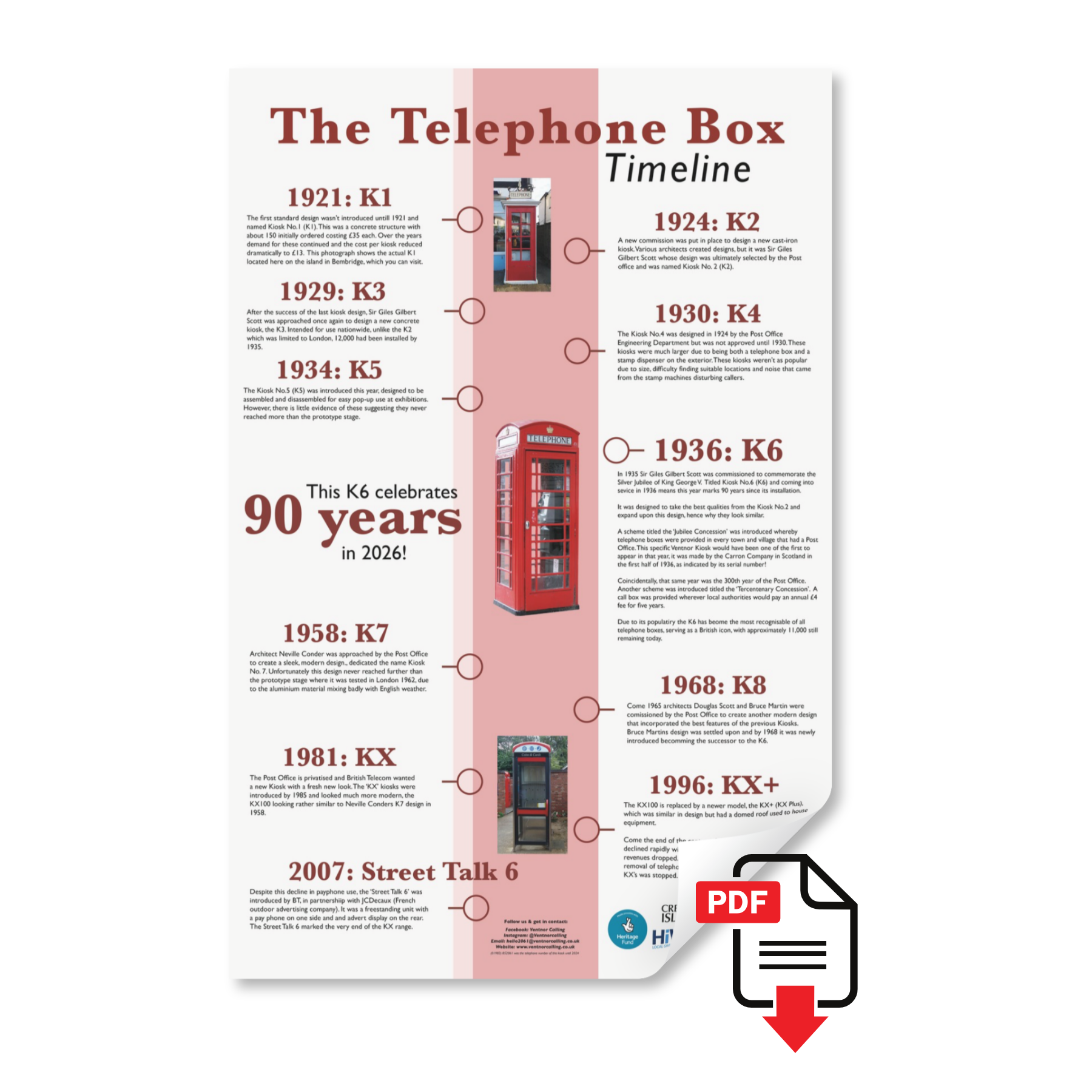
The K6 was just one chapter in the story of Britain's public telephone kiosks. From the concrete K1 of 1921 to the modern Street Talk kiosks introduced in the 21st century, each generation reflected changing technology and the way people communicated.
Download our illustrated Telephone Box Timeline to explore the evolution of Britain's most recognisable street furniture.
Connecting Communities
Before telephones became common in homes, public kiosks were an essential part of daily life. People used them to call family, arrange meetings, contact businesses and report emergencies.
For many visitors, the kiosk was one of their first stops after arriving in Ventnor. Every call made here passed through the operators at Ventnor Telephone Exchange, where the town's famous Hello Girls connected calls by hand until the exchange became automatic in 1971.
Together, the kiosk and the exchange tell the story of how people stayed connected before the digital age.
A New Chapter
As mobile phones replaced public payphones, thousands of kiosks disappeared from Britain's streets. Fortunately, many communities recognised their value and stepped in to save them.
Ventnor Calling is proud to care for this adopted BT kiosk, preserving not only an outstanding example of British design but also the stories and memories it represents.
Today, the kiosk is beginning a new chapter as a place where local history can be discovered, shared and celebrated.
More than a telephone box
The kiosk may no longer ring with the sound of "Number, please?", but it still has stories to tell.
By preserving this small red box, we're helping to preserve something much bigger—the history of communication in Ventnor and the people who kept the town connected.
A few interesting facts
- Designed by: Sir Giles Gilbert Scott
- Introduced: 1935–36
- Official name: Kiosk No. 6 (K6)
- Purpose: To celebrate the Silver Jubilee of King George V
- Made from: Cast iron
- Listed status: Many surviving K6 kiosks are now Grade II listed because of their historic and architectural importance.
- Estimated number installed: Around 70,000 across the UK, making it by far the most common traditional British telephone kiosk.
- Still in use: Although many have been removed, thousands remain thanks to local communities who have adopted them for new uses.
